
A guide to club racing - part 3 (the start line and the course board)
Published 15:07 on 7 Jun 2026
OK, you may find it strange that this article covers both the course board and the start line but as you will find very quickly they are in fact intertwined. Also there are many people in the club with a great knowledge of this subject who can explain it in the context of the "Racing Rules of Sailing", but for the purpose of this article I am writing it as a "lay person" with a developing knowledge to aid newcomers so if I get phrases or terminology slightly out of skew please forgive...
So why are they intertwined? Well up to last year we normally had everything really simple.
- X was the start line
- We then went around a load of cans
- Then we came back through X to finish
So what happened?
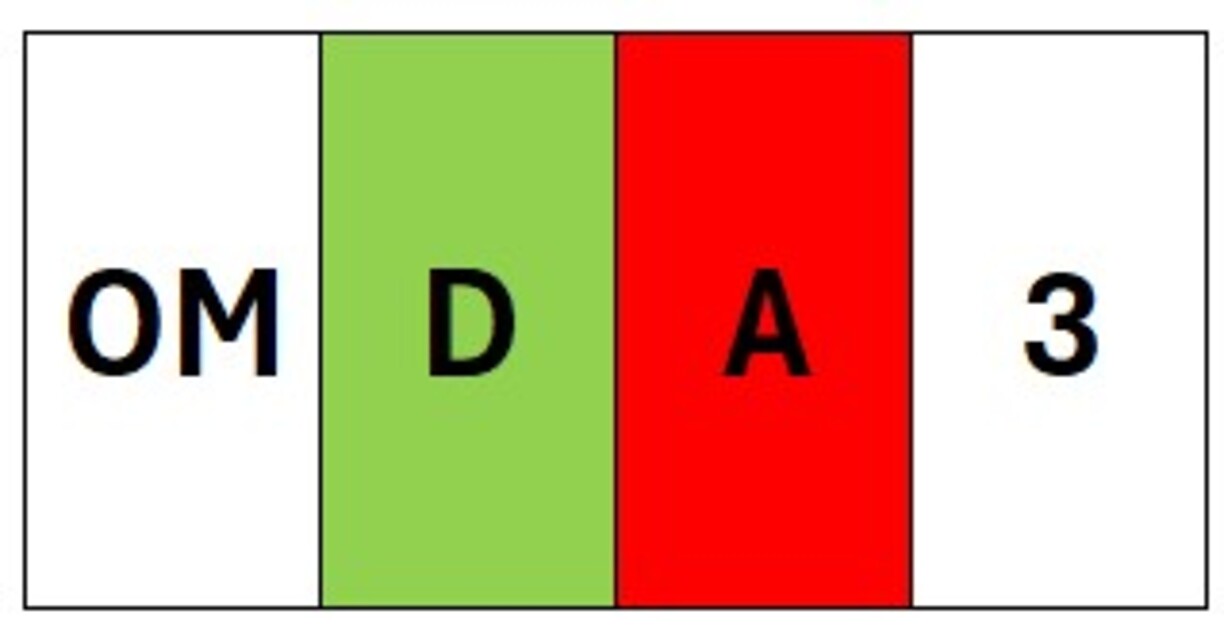
Well one race officer, due to wind direction shift, decided to drop an "outer mark" pin, then another certain race office decided to mix it up a bit and remove the start line notation everyone was use to from the course completely. Both of these are in the Race officers gift and make club racing more interesting but it was clear that certainly the less experienced racers amongst us were not quite sure what was going on.
Now I have a confession to make, a few weeks ago "said" race officer did the same thing again, and noticing it on the race board, and not being sure what to do, told my helm to "follow the K6" as they seem to know what was going on. Not the best tactic, knowledge is better! so here is the low down on start lines and course boards.
So lets work on a couple of principles (as I said I am writing this to inform the less experienced so it may not be totally in the "correct language" -but hopefully it's an explanation that will land with most.
PRINCIPLE 1 - THE COURSE BOARD
So here is a typical course board:
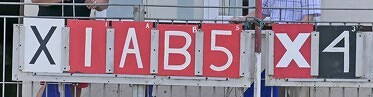
Lets think of it in parts as follows
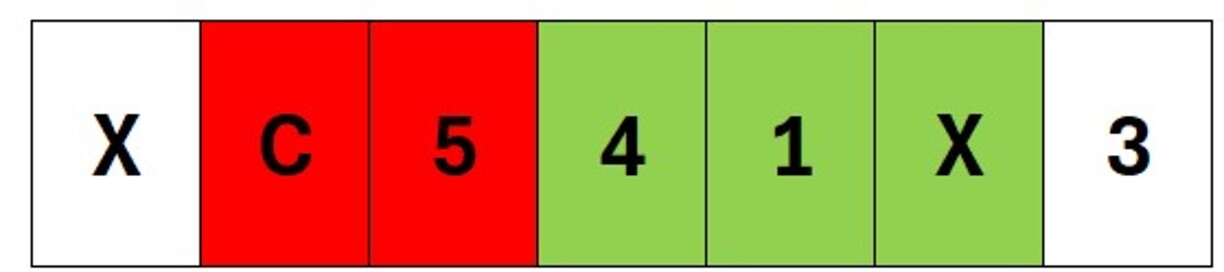
Part 1 - Start line - in our picture the Black X
Part 2 - Course - in our picture the red 1,A,B,5
Part 3 - Last mark on course (which also defines the finish line) - in our picture the red X
Part 4 - Number of laps - in our picture the number 4 in white on a black board
PRINCIPLE 2 - THE START AND FINISH LINE
So lets start by defining a term which we will use a lot and that is a "transit"... so what is a transit? Well as you can imagine, we do not sail across a "physical line", if we do we might get caught up in ropes, so our start and finishes, use an "invisible line that we visualise ... let me explain using the photo below
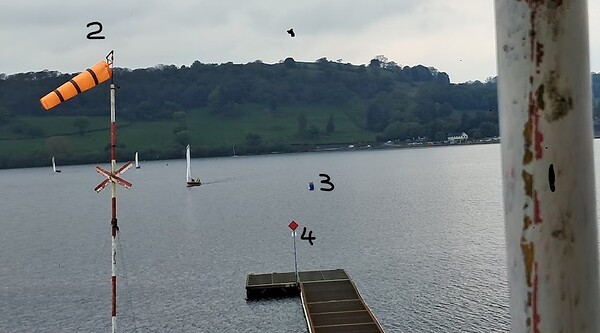
So what are these points?
Diagram point 1 - The pole of the race bridge flying the orange flag
Diagram point 2 - The moveable windsock (with an X on the top)
Diagram point 3 - The X mark (currently with a T on it)
Diagram point 4 - The water level sign on the end of the jetty - NOTE THIS IS NOT A RACING MARK
Not in diagram - A dropped thin "PIN", sometimes with a flag on top - NOTE this is an outer mark and not the actual transit point of the line. The "actual line" is the transit as explained below
So to create the line you need two fixed points. The first one is a constant for club racing as we always run it from the bridge and that is the orange flag
The second point THAT CREATES THE LINE will either by the X mark or the movable windsock on the shore with a X on the top of it
Finally the start line needs an end point for us that is either the X mark or the dropped pin depending on what is the first identifier on the board
So lets take a look at 3 valid course boards you may see at club racing and how that affect the start, course and finish:

- Start line transit - Orange flag and X,
- end point of start line - X
- Must pass X to startboard during race - Yes
- Finish line is a transit from Orange flag and X
- 3 laps

- Start line transit - Orange flag and the moveable wind sock flag,
- end point of start line - the outer mark pin
- Must pass X to starboard during race - Yes
- Finish line is a transit from Orange flag and X
- 3 laps
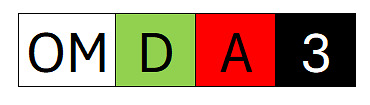
- Start line transit - Orange flag and the moveable wind sock flag,
- end point of start line - the outer mark pin
- Must pass X to startboard during race - No
- Finish line is a transit from Orange flag and MARK A
- 3 laps
So thats the start and finish lines sorted out, but a quick explaination as to why the Race Officer might use an Outer Mark as opposed to the fixed start mark?
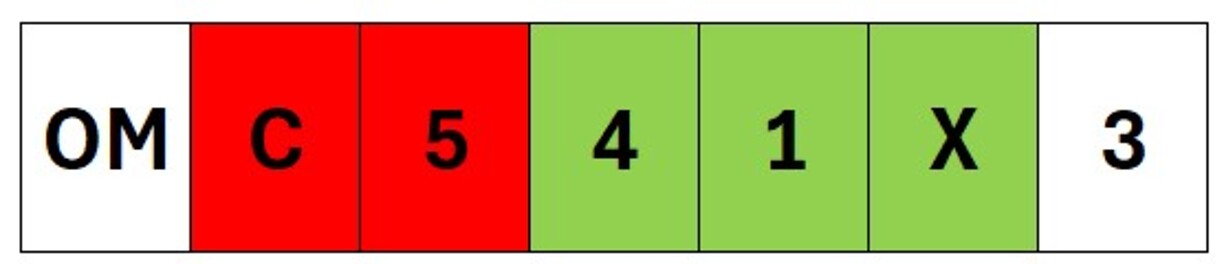
Well, the first reason to use OM would be when there is not enough room on an X line to safely accommodate the number of boats racing. The OM mark would be placed further out extending the start line.
The second reason for using OM would be to square up the start line, ideally the start line should be at 90 degrees to the wind direction which is not always the case when running racing from the bridge.
You do need to check however on the water whether the OM outer limit marker is above or below the transit line. The outer limit marker could be above or below the start line. Remember the "physical line" is taken from the transit points the Outer mark only tells you how far out that goes. (See diagram below):
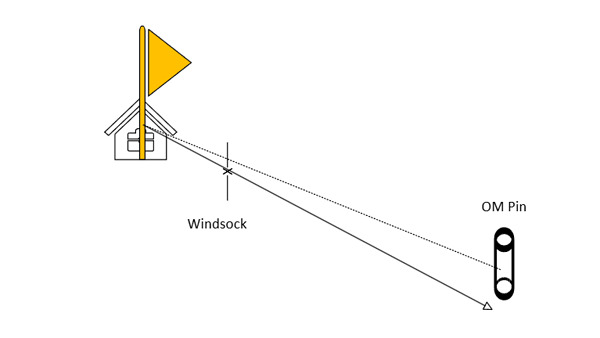
From this you can see the Orange flag on the race office and the X on the windsock with a solid back line being the actual start line. Whilst the Outer mark pin is slightly ahead of this line (dotted transit), that is not the start line, the solid line is. The Outer Mark Pin only defines the end of the line, not the transit.
So we can now quickly look at the main letters and numbers that make up the course.
When setting the course, the RCO is encouraged to follow a number of good practices, the main 3 (there are more) being:
1) Start upwind
2) First mark is rounded to Port
3) The course should be a mix of a run; (gives sailors decisions to make downwind); a reach (beware: spinnaker boats struggle if too tight); at least one good beat. NO fetches (a leg whenfairly close hauled between two marks but no tacks needed)
So if we look at a typical course board (discounting the start and finish elements), marks taken to Port are shown in Red and those to Starboard in Green:
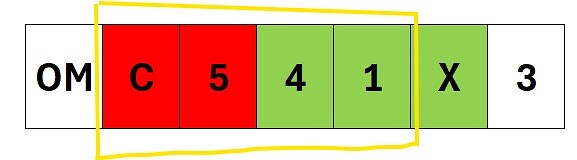
In this situation after going through the start line we then:
- Sail down to C and take that mark to Port
- We then sail across to 5 and take that mark to Port
- We then sail across the lake to 4 and take that mark to Starboard
- We then sail up the lake to 1 and take that mark to Starboard
We then pass through X to Starboard as a mark of the course or the finish line
Ok, so you have now master the start you have written the course down with a Chinograph pencil somewhere in your boat and you know where the finish is.... we also know that based on the course board its 3 laps. BUT you are in a race in your Topper with a bunch of RS100's, Mike in his D-Zero and Steve in his Spitfire! There is a strong probability that whilst they get 3 laps in you might only do 2. It could also be a situation where everyone is on the same lap but the original plan to run say 5 laps is not possible becuase the wind drops and the race officer wants to finish the race at 3 laps. In this instance the Race Officer will fly one of 2 flags:
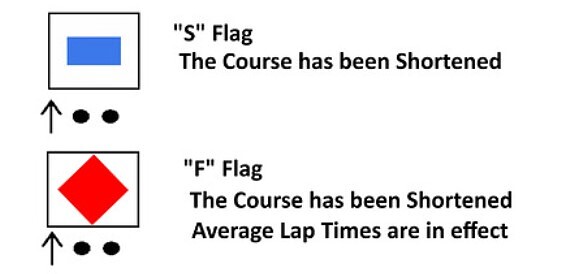
The S (Sierra) flag which is a blue rectangle on a white background will be flown from the race office if all boats are on the same lap and the race officer wants to finish the race on that lap. At the point it is raise, you will hear 2 short horns. As you cross the line, you will get a horn hoot to confirm you have finished.
The F (Foxtrot) flag which is a Red Triangle on a white background will be flown from the race office if boats are on different laps and the race officer wants to finish the race as a slower boat comes around. At the point it is raised, you will hear 2 short horns. As you cross the line, you will get a horn hoot to confirm you have finished.
I know this article has given out a lot of information but hopefully it has been written in a way that encourages you to get out racing by giving you sufficient knowledge to know the basics.
As your time on the water, especially racing expands, it is useful to read the Sailing Instructions,and reverse side, the Racing Marks and Signals and the Notice of Race. These are formal documents which underpin what you have been told and are common to any sailing racing event.
You can read our next article which looks at the rules which govern general rights of way here.
You can go back to our main article with the full list of articles here.
Downloads
Last updated 20:47 on 8 June 2026