
A guide to club racing - part 6 (Sailwave, results and what do the codes mean?)
Published 21:32 on 9 Jun 2026
OK, you've finished on the water and it's time to get into the back office and sort the results out. Why are we telling you about this? Well firstly, it is treated as a bit of a dark art but actually once you understand the basics not only does it add to your enjoyment and understanding but also it can give you a little tactical advantage of moving up the leaderboard, but more on that later.
The way I am going to approach this is throw a load of information at you and then hopefully at the end show you some examples to bring it all to life.
So lets start with the basics. What is Sailwave?
Well its an off the shelf piece of software that a large percentage of clubs use to create and manage their race results. Why is it so good? Well it takes all of the hard work away from the race office and takes care of all of the calculations and tables. As long as you key in the right information it crunches it all in the back ground and gives us the results.
Is there a set of standards?
Yes there is, the main three are as follows;
1) WS Appendix A - this is a set of rules governed by "World Sailing" and refers to the scoring section of the Racing rules of Sailing. As well as the points system it also covers things like how scoring ties are managed and standard abbreviations
2) Within Appendix A, is a Low Point and High Point scoring system. We use Low point for Club Handicap Racing and High Point for Club Pursuit Racing. We will explain this in more detail later on
3) Handicap System - Most club racing is managed under the "Portsmouth Yardstick (PY)" system although other handicap systems such as Great Lakes (sometimes used for large lake inland racing) and SCHRS (Small catamaran handicap rating system) are other common ones. We use PY for club racing and opens and SCHRS for out Multihull Open
What is a Discard?
When you have a series or regatta with multiple races, it is common to allow competitors to "discard" their poorest results. This is common in sail racing and takes out some variability.
For club handicap racing we operate (N/2)+1 where N is the number of races in the series. So for a 12 race series, (12/2)+1= 7. This means that the best 7 races will count and the worse 5 will be discarded. This means if a person missed a couple of weekends, or had a bad couple of results it normalizes their results in the table
For opens, we always state the number of discards in advance so that competitors know what number of races will count. A typical wording could be:
a) When fewer than three races have been completed, a boat series score will be the total of her race scores
b) When three or more races have been completed, a boats series score will be the total of her race scores excluding her worse score
What are the codes I sometimes see in the results?
Over the last few years we have simplified the commonly used codes underpinned by the WS Appendix A as follows where
N = number of boats in a specific race
X = unique number of boats which have entered the series (even if that are not racing in that race / weekend)
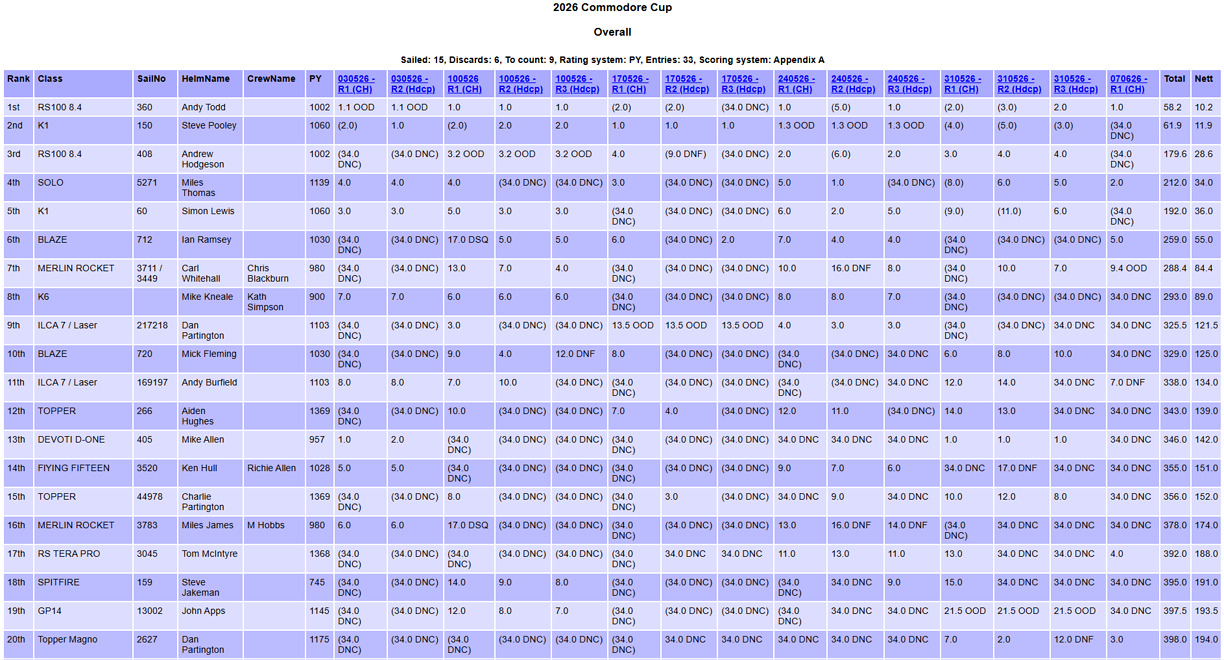
DNC - Did not start. If a boat is in a series and did not come to the start line for a given race then they score X+1
DNF - Did not finish. If a boat starts a race but does not finish then they score N+1
DSC - Disqualified. To be honest we don't really use this because we are all so friendly but if we did it would be N+1
NSC - Boat did not sail the required course as defined by rule a5.1 such as missing a mark then they will score N+1
OCS - On course side. Boat went over the start line early, a single recall was sounded and they did not action it, then they score N+1
ODD - Race officer duty. If you are a regular racer and do duty, so you are not penalised, for each race missed we give you the average of your non discarded races
What is the difference between High and Low point?
OK grab a cup of coffee, you are may need to focus...
Low point:
- This is nice and easy.
- We use it for Club and Opens handicap racing
- Time on water is adjusted using the PY to create an adjusted time which defines the competitors position. Where competitors do different numbers of laps, average lap times are calculated
- Discards are used as DNC races can drive a high point count
- Points correlate with position so first scores 1 point, second 2 points, third 3 points etc etc up to the last person IN THAT RACE
- Person with the LOWEST number of points at the end of the series / event wins
A typical race table would look like this
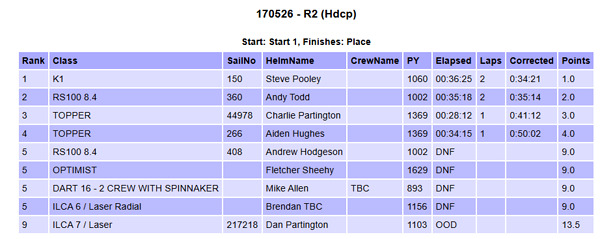
Have a look at the table below and see if you can pin point any of the points above
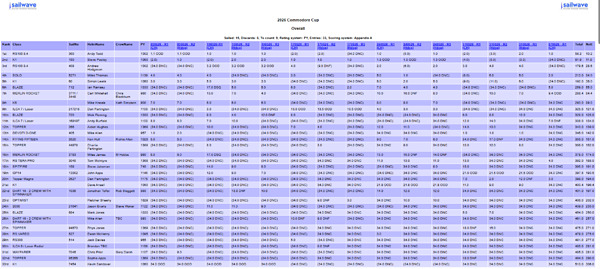
High Point
- Is more complex
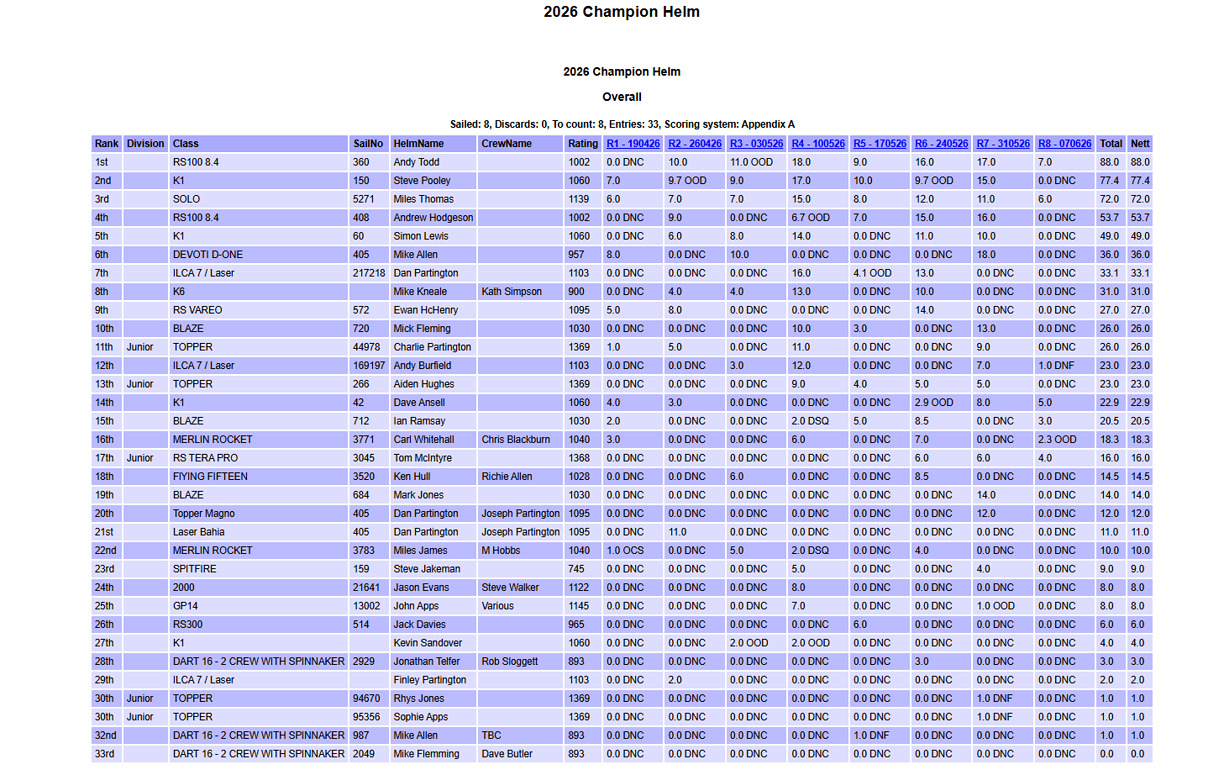
- We use it for the Champion Helm
- Discards are not used as non competing sailors do not score points (unlike DNC's in Low Point)
- Points are a reverse correlation of the number of competitors in that unique race
- So a race with 5 competitors, first scores 5 points, second 4 points, third 3 points, fourth 2 points and fifth 1 point
- A race with 10 competitors, first scores 10 points, second 9 points, third 8 points, fourth 7 points and fifth 6 points etc etc
- Person with the HIGHEST number of points at the end of the series / event wins
- This means that in races with a larger number of competitors, significant gains can be made as more points are available
Have a look at the table below and see if you can pin point any of the points above
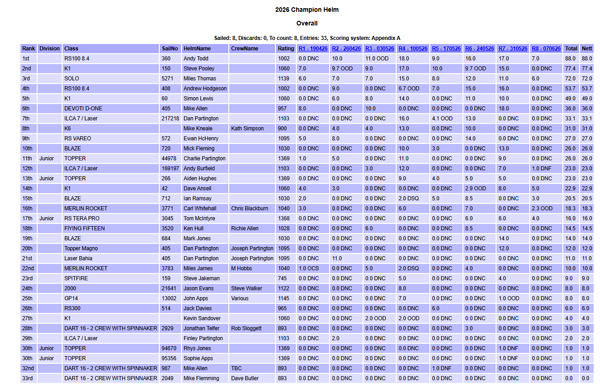
Hopefully this is added to your knowledge and gives you a little bit of an insight into how the scoring of racing and your participation affects your position on the score board.
Last updated 17:28 on 10 June 2026