
A guide to club racing - part 1
Published 14:32 on 4 Jun 2026
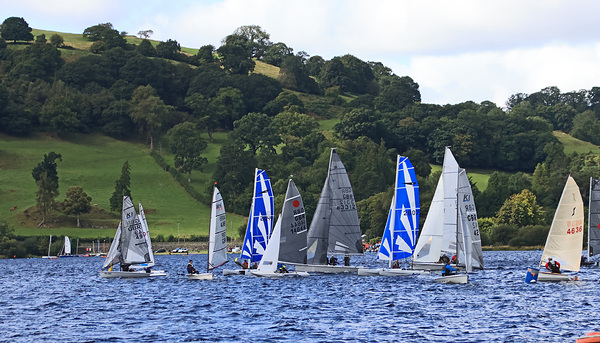
Welcome!
If you are reading this you are either an existing club racer who is trying to work out if they are doing it right or hopefully (as the target audience of this first article in the series) someone who is getting a bit interested in having a go at club racing but wants to know more (or like me at the start of my racing period, didn't have a clue what was going on and was genuinely worried about mucking it up!)
So lets dive into the absolute basics and then future articles will give you more information:
So what is club racing and how and when does it run?
Club racing takes place most Sundays and it is split over two trophies
Morning @ 11:00 start - Champion Helm
A Pursuit Race (see below) which lasts either 60 minutes or 80 minutes depending on conditions. The series runs for the duration of the season.
Afternoon @ 13:00 to 13:30 Start - Series Trophy
We run a number of shorter series (normally 6 to 8 weeks) which are 2 Handicap Races (see below) but we also include the results from the morning race into the series table
What is a PY?
Not all boats are equal and it would not be right to expect a Solo to match the speed of a RS100 or a Topper to keep up with a Spitfire, so each boat is give a PY number. Think of it as a unique boat handicap score. If you take a midpoint handicap as 1000, faster boats move down from it (so a K6 which is a faster boat has a PY of 900) whilst slower boats such as a GP14 would have a PY of 1145 and move up from the 1000 mid point. Each year the RYA issue a PY table based on sailing clubs submitting their race results so it is based on real data. Sailing racing uses PY's to even the playing field regardless of the type of boat you sail. As long as we can find a PY for your boat, you are free to race it!
Pursuit vs handicap
At the club we run two types of racing, a Pursuit in the morning and Handicap racing in the afternoon. So what is the difference?
Pursuit racing
- We ask racers to sign on in the race office by 10:30 so the start sequence can be decided and racers informed
- Course is shown on the race office board before the first boat gets away
- Racing starts at 11:00
- The slowest boat on the day starts first (11:00) using a standard 3 minute start sequence (see below)
- All other boats are given a specific start time based on their PY provided by the Race officer on the day. On their designated time they get a single horn signal
- This means that boats all start staggered based on their PY
- At the end of the 60 or 80 minutes an end signal is sounded and the race ends (regardless of where you are on the water) - you are then free to sail back to the clubhouse, you do not need to go around any more marks
- The race office monitors who has caught who up and knows your order on the water. Your final position is defined by this
Handicap racing
- We run 2 races "back to back" so after the first race finishes we go straight into the second race
- We aim to start after the lunch break so its around 13:00 to 13:30
- Course is shown for each race (yes it will be different for both races) before the start sequence
- All boats start at the same time
- A 3 minutes start sequence is used (see below)
- The number of "laps" is shown as part of the course but for slower boats we may "shorten the course" which means that some boats may do 3 laps and some only 2. In this case we use the average time for your laps. You will always get a horn blown when you cross the line so if the course has been shortened you get an audible signal to let you know you have finished
- Your "time on the water" is then adjusted using your PY rating so whilst you may cross the line in 7th place you could end up in 3rd place once your time is adjusted
How we start
For Handicap racing we use a 3 minute start sequence (which means that 3 minutes before the race "starts" we get you ready to go). Each minute (ie at 3, 2, 1 then go) we position or display a flag on the starting bridge and sound a horn in a set sequence. Most people have a racing watch which they set off at the 3 minute horn and it counts them down. We will do another article on the start sequence later on in this series which will explain this in more detail. Don't forget that for the "Pursuit Race", only the first boat has the 3 minute sequence, all other boats just get a single horn.
Whilst there are a couple of variations on the start line, the standard line that we use (when racing from the bridge - which we do for club racing), is a invisible line drawn between the middle of the flag pole (displaying an Orange flag) on the racing bridge and the X race mark (currently showing a T I think) on the water in front of the bridge.
The course (and remembering it)
Prior to the race starting, the Race officer will display the course on boards on the race bridge. Once again, whilst there are a couple of different configurations, the most common one we use for club racing is a follows
{start pin} {course} {last mark of the course which is also the finish} {number of laps)
so a typical course would read as follows:
X 5 4 B 1 X 4
and this breaks down as follows:
{start pin} = X so the start line is a virtual line between the pole with the yellow flag on the bridge and X
{course} = 5 4 B 1 you will notice that the 5,4 & 1 are in green and the B is in Red. This means that we are going down to mark 5 taking it on our starboard side, then across to 4 taking that to our starboard side, then up to B and taking that on our port side, then up to 1 taking it to our starboard side
{last mark of the course which is also the finish} = X Once again, whilst the starting pin X (above) is shown in black, the last mark of the course which is also the finishing pin is shown in green denoting that this must also be taken to starboard
{number of laps) = 4 this indicates how many laps you need to complete before the race finishes (unless the Race office shortens the course)
My best tip is to buy a box of chinograph pencils from Amazon, keep a couple on you and that way you can write the course somewhere on your boat each time.....
How we can help you on your first few times out racing?
The best way we can help you out is firstly by letting us know that you are keen to start racing or if you are attempting your first race let us know on the day. That way we can do a couple of things:
1) Don't rush the start. You will find it very daunting the first time, as boats hustle to get the best position and be first over the line. Hold back, pick an experienced racer and watch what they do and the lines they take but hold back from the main group. Get comfortable with the sequence even if you are 15 seconds late over the line (don't worry, I can guarantee there will be experienced racers who time it wrong!) The key thing is to build your confidence and understanding of the start sequence
2) We can let the safety boat know that you are new to racing and they can follow you around on your first few laps, checking that you are OK with the course. Also if the race is likely to be a shortened course, we can make sure you are advised of this as you come around
3) Think about crewing? Pop on the whatapp group and offer to crew with someone. If you are not ready to go solo, a great way of learning is to buddy up on a boat with someone else
Over the next few weeks we will be dropping articles on the following, but for now if you have any questions or are keen to get racing, please give us a shout.
2) Course board notation and what it means for the start/finish
4) What to do at the mark (rights of way and tactics)
5) How results are created, Sailwave and scoring codes
6) Sailing to win - windshifts, laylines, picking the best line etc
Next Article >>>>> The start sequence
Last updated 12:40 on 10 June 2026